Sujet résolu
L'auteur a trouvé une solution à son problème.






Sponsorisé
Connectez-vous pour masquer les pubs


YouTube
Vidéo YouTubePSG dominated and controlled the game from the start to the finish. Alonso showed some great ideas for the previous matches with Real Madrid. However, due to injuries, suspensions and tactical choices, things didn't go according to the plan. Alonso opted for the 4 4 2 diamond. Compared to other formations that are slightly more linear in their matchups, the 4 4 2 needs to choose how they want to close down the fullbacks. You can either choose to push your fullbacks forward and shift the defense over to cover this side of the pitch, giving you more midfield cover but being slightly more vulnerable to switchese in play. Or alternatively, you can press with the 2 midfielders shifting over to the fullbacks which allows you to have more cover on the defensive line, but potentially leaves the midfield a little more exposed for quick combinations. Out of the 2, the latter is arguably the most common approach as it's a slightly more linear rotattion However in this case, it was very costly for Real Madrid. And PSG knew how to exactly exploit it. There are 3 components in this game that allowed PSG to dominate. Firstly the front 3 of Vini, Mbappé and Garcia. They all had some good moments during this club world cup, especially Garcia. However, Vini and Mbappé's pressing was the main reason why PSG was so dominant in possession. The lack of intensity in the press made it very easy for PSG to break forward and exposed the midfield to all of the rotations further up. When PSG were in possession, they made sure to keep their backline slightly deeper than they usually would, meaning the front 3 were often too far away from the backline. PSG' searly goals may seem like good fortune, taking advantage of mistakes at the back from Real Madrid. But PSG made their own luck and the intense press from Dembélé is a perfect contrast to what was lacking for Real Madrid in this game. So, this weak press allowed PSG to control possession.
But the second key component is down to these rotations out wide onto the fullbacks and how PSG completly took advantage of this. As the backline rotated positions, either Guler or Bellingham would step out. But because of the distances they had to travel, there was often a lot of time for this ball to be played forward or even into the center. To add to this problem, the fluid midfield of PSG would vacate the center of the pitch nearly entirely at times, shifting further and further out wide to receive the ball, overloading the flanks and leaving players like Bellingham completly in 2 minds of which player needed to be covered. There were many examples in the firs thalf of these rotations away from the center. And as PSG circulated possession from flank to flank, they had a lot of easy avenues to move the ball forward. In fact the vast majority of these progressions came from these spaces out wide. All these problems were particularly evident for Real Madrid in the build up that led to the 3 - 0 goal. Mbappé and Vinicius tried to shadow mark any pass into the center but are not applying any pressure to the players in possession. As Donnarumma moves the ball out wide onto the right flank, Bellingham has to cover a lot of ground to close down Hakimi, completly leaving the center of the pitch vacated, which is occupied by Doué moving from his usual winger position to the center. A double 1 2 on the flank from Hakimi and PSG completly ripped Real Madrid's defense. PSG also adapted quickly. As Alonso started to adjust these rotations out wide, they started to jump the gun on the press on the fullback. This meant they would make the movement before the center back made the pass, which PSG exposed brillantly in a couple of occasions, by skipping a tempo and going directly into the winger who rotated into the half space. It's worth noticing that passes like this are easier if the pressure on the defender isn't intense enough.
The third and final component that allowed PSG to completly dominate this game was their aggressive press in the exact same setup that we saw in the UCL final. The speed at which they closed dowdn the keeper, forcing long balls and aggressively closing down the midfielders meant Real Madrid were rarely dangerous in the flanks. Mbappé and Vinicius struggled to latch on to these long balls and once possession was lost, PSG were quick to get forward and dominate possession. The only real occasions Real Madrid had in this game came from the counter attacks But even here they weren't able to carve out any seriously threatening chances. Eventually towards the first half, Alonso attempted to adapt to this defensive shape, switching to a flat 4 4 2 with Garcia dropping alongside the midfielders. This allowed them to close down the fullbacks a bit quicker Overall they were able to limit the damage in the second half, conceding late once the game was already done. But this tactical shift came a bit too late. The few times Real Madrid were able to build an attack, there were some glaring issues in this position as well. In fact, the 4 4 é diamond is a great shape to use with more fluid and dynamic players, as the close proximity in the center can lead to some interesting combinations. like we've seen a lot from Real Madrid in recent years. However, with a manager like Alonso who wants to give his team a bit more structure, this shape means it's difficult to occupy the space out wide. It requires either the fullbacks to be aggressive and join the attack, or for the midfielders and attackers to rotate into these positions.
But against PSG, because the fullbacks were often pinned back by the wingers, it meant it wasn't easy for them to join the attack. And because of the aggressive press, Real Madrid tried to get the ball forward quickly, so would find themselves in a position in the center, but with little option to move the ball out wide. There were a few moments where Real Madrid were able to stretch the defense more consistently during the second half, but the final shot was an accurate reflection of Real Madrid's performance in this game. Personally, I think the back 5 Alonso has been trying at the club World Cup could be the best solution for Real Madrid next season. It gives them great defensive cover with the wingbacks out wide. And offensively, it does allow them to get a lot of players forward on the attack. However, because Alonso is so reliant on an aggressive press to regain possession quickly, I don't think that Mbappé and Vinicius working together is the solution as both of them don't have the willingness to press effectively and efficiently.
il y a un an

YouTube
Vidéo YouTubeChelsea started the match in a 4 2 3 1 with the curious choice of Reece James as the holding midfielder alongside Caicedo Defensively speaking, Caicedo and James would follow Neves and Ruiz not giving them any chance to rotate. As PSG looked to build, they would drop into a wide back 4 with Vitinha also dropping deep to try and receive the ball. Initially he would have space between the front 2 of Fernandez and Joao Pedro to rotate possession. But as he would move up on the pitch depending on which side they they were building down, either Caicedo or James would step forward to close him down and Chelsea's defensive line would break with one of the center backs pushing forward to close down any player in the midfield. It led to a mix system for Chelsea as it was man marking in the center of the pitch but a slightly more zonal first press in the space out wide. It led to a very dynamic defensive line. We know that PSG players are known to rotate continuously. Players can start into the midfield but rotate into attack and the front 3 have the freedom to move into deeper positions. So Chelsea were continously swapping positions, changing which way they formed the backline. But whoever stepped into the backline was then keeping the same shape in an organized way which is extremely difficult to do consistently. Neto was a lot of time helping Chelsea to form a back 5, essentially playing as a wingback. PSG often use Hakimi to bring the width with the right winger Doué often moving more centrally. That's why Chelsea were shifting into a back 5 when PSG had possession. It allowed Cucurella to stay tigher on Doué and follow his rotations more closely. It also meant there was an extra player to form the backline if Cucurella was to step forward.
A few times in the first half PSG could find space on this flank by timing their runs well and finding a player in behind. But they barely could create chances. It meant that in deep positions, Chelsea were often in a 5 3 2 shape to close off any chance of central progression. If PSG attempted to play centrally, James and Caicedo were perfect in this game and quick to close down any player in the center. As PSG struggled to find space on the middle, Dembélé was dropping deeper and deeper off the defensive line to receive the ball, often hovering around the left channel. This position could cause some small issues for Chelsea especially because of this fluid defensive system. In the second half, Chelsea dropped a bit deeper in the pitch when defending, meaning that players like Vitinha had more time on the ball. to push forward and on a few occasions did break through the center, often leading to long range efforts or play shifting out wide. However outside of Dembélé's big chance in the second half saved by Sanchez, Chelsea defended perfectly. Outside the saves, Sanchez was very good on the ball as well.Sanchez was a key to how Chelsea could be dominant in the first half. When the opposition is building from the back, PSG want to be aggressive and Dembélé is tasked to rush to the keeper constantly when he has the ball. Chelsea was playing with Sanchez almost entirely from Chelsea's left, ensuring that PSG was more shifted to Chelsea's left flank so there would be more space to the right for Chelsea to exploit. From the right flank, they almost never used Sanchez.
On a few occasions during this season, Sanchez was trapped on his weak foot so by not putting him into this position entirely, it meant he had a much bigger impact on the ball. This is what led to Chelsea's first goal with Gusto forcing a mistake from Mendes before Palmer could finish. Chelsea had Pedro moving into this right flank. The second goal came from Chelsea winning the ball back in the center, catching PSG off balance and the third goal was thanks to a perfect rotation. The moment Chelsea had the possession, we saw their 2 3 5 shape with Cucurella, Caicedo and James forming the middle line, forming a sort of defense before the last defensive line, pressing relentlessly and not allowing PSG to create any dangerous counterattacks. In the second half, Chelsea looked to defender a bit deeper to keep that scoreline and create chances from counter attacks with Liam Delap having a great impact on the game, forcing 2 good saves from Donnarumma.
YouTube
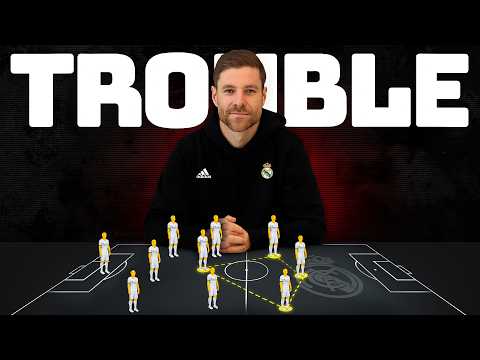
Vidéo YouTubeXabi Alonso used 3 different formations during the Club World Cup, each one desigend to correct flaws from the previous one. No matter the formation, Alonso builds up the sasme way, with a back 3. It starts with Courtois. Under Ancelotti, Courtois was more of a traditionnal goalkepper, rarely venturing beyond his penalty area. Whenever Real Madrid beings deep, if they begin with the back 4, he has to push up between the center backs to create that vital 3. By doing this, Alonso doesn't have to drop another outfield player deep to create the initial numerical superiority. This extra man can push higher up the pitch where he can hurt the opponent. Football has an endless cycle of creating a tactic, an opponent countering it, and adaptaing to this counter. In possession, they were rarely in a midfield 3 when Trent was playing, because he was inverting into the midfield to create a 4 man midfield. Formations are just the vocabulary, principles are the language of football. And the principle here is the desire for Alonso to have a central overload in order to take the most direct route to the goal. But most of the opponents anticipated this, meaning that the opposition mostly defended in a narrow and compact shape, mostly with a front 2, which is why Alonso wants to build with a back 3 : to have an easy outlet. The back 3 changed depending on the match. Against Al Hilal, Fran Garcia was the third man, as the left center back. Whether Madrid used a midfield diamond or a back 5, Fran Garcia was not expected to invert at all but isntead stay wide. This cause major issues because in the diamond and the back 5, he often found himself isolated. This is a situation Madrid should aim to avoid. When he got the ball, the opponent's press suddently kicked into high gear. The thing is that passing ability is not Fran Garcia's main strenght. Garcia often went backwards as well, especially since he had no easy support ahead of him.
The adaptation for Alonso involved a slight tweat in the role of Vinicius. Initially when Fran Garcia received, Vini was more central. but as the tournament progressed, Fran Garcia was a signal for Vinicius to immediatly move wide in support. They could pin the fullback deep to give Fran Garcia more time on the ball, as most opponents were reluctant to commit a central man to press Garcia due to Real Madrid's central overload. But even if Garcia was still under pressure, at least now he had a simpler option up the line. The Vinicius solution helped when Garcia was isolated out wide. When Madrid was building in a back 4, the inversion meant that Huijsen ended up being the central center back. But in a dedicated back 3, he could start and remain as the left center back. From there he showed the composure and passing range that Garcia lacked, meaning that he could play those penetrative passes into the Madrid midfield advantage to take hold. However, the teams were still defending narrowly. Real Madrid needed to get outside of that. So Real Madrid's back 3 couldn't just remain static, which is why Huijsen moved to these pseudo left back zones. This completly changed Madrid's dynamic. Huijsen was an excellent ball carrier when he received, very comfortable with the ball at his feet. So he pushed higher up the pitch to get the ball into areas where he could potentially find the creative players in their most effective zones. Because of that, Garcia was no longer stuck deep and played higher up the pitch. where his greatest strenght which are his pace and his running actually mattered. With Vinicius drifting wide into the half space to draw defenders, Garcia Fran Garcia could make overlapping runs that suit his game perfectly.
il y a un an

However this back 3 / 5 was a problem when Madrid needed to use the diamond formation. Back then vs Al Hilal, Tchouaméni and Valverde formed the double pivot. Even tough they are not bad passers by any mean, Madrid needed more thrust from these deep pivot positions because the likes of Trent and Bellingham in those half spaces didn't see enough fo the ball in thes zones. So later on in that match, Trent and Valverde began to rotate more to allow Trent to dictate more the passing. But as Alonso moved from the 4 3 3, both the back 5 and the diamond are narrow shapes with complete dependence on the fullbacks to provide all of the width. This meant that there was no more inversion of Trent into either the midfield, either as a third center back. Most of his career, Guler played either as an attacking midfielder, aither as a winger, or as a central midfielder. But with Trent no longer inverting, ball progression from a double pivot of Tchouaméni and Valverde would be even worse. Guler now instead of playing as a 10 being at the end of progressive passes, started to become Madrid's main deep playmaker due to both his passing ability and his ability to play on the turn. Instead of passing to the forwards as he used to do as a 10, he would now use his passing to break the lines. To put it simply, he is taking the Toni Kroos role. We even saw Arda Guler as the third center back during Madrid's build up on the left handside of the pitch. However when Madrid switched to a diamond or a back 5, Trent had no longer a winger ahead of him. They executed their signature switch of play. It would be him receiving the ball in wide areas rather than a natural winger like Rodrygo.
The problem is that Trent is not used at his best in this situation, unless he is crossing immediatly. Often, in some scenarios, Trent was isolated in his natural right back position and had no option ahead of him unlike Garcia who had Vinicius drifting into his natural wide position, Garcia preferred to stay centrally, meaning Trent had no support. In a diamond, Bellingham would often go to right half space when he recognized these occasions, ahead of Trent. Valverde also from the diamond but more often from the right of the midfield 3 when they operated in a back 5 would make similar runs with defenders either be dropped to deal with the run, thus giving Trent more space and time on the ball, or if they still insisted on pressing Trent, now he had a man in the half space that he could look to find with the pass. This could drag defenders across, making the opponent's defensive structure more vulnerable. As for Bellingham he was often the midfielder with the most freedom and as a result the most responsability in the final third. This involves linking up the play between the midfield and the forwards but also crashing into the box, especially when Vinicius or Mbappé go drifting. But this makes moving the ball into Bellingham into these dangerous positions even harder because of the teams stacking the center. This is where Guler's ability to break the lines from deep become crucial. While Real Madrid's possession play is promising even with if it's far from perfect, Real Madrid's defensive structure in the other hand, seem to be a failure still.
Because perfect possession is pointless if you can't win the ball back to use it. Their pressing structure is fundamentally broken. For every goal kick, Alonso wants his team pressing very high up the pitch to win the ball back in dangerous areas. Regardless of the formation, the pressing shape has looked almost identical, a front 2 immediatly applying pressure on the center backs, wtih a midfielder picking up the opposition pivot and 2 players positionned narrow to cover the central zones but also ready to press the wide regions. In their 4 3 3 formation against Al Hilal, this meant that Bellingham pushed up to support the forwards and Valverde had to advance from deep and both wingers tucked inside. This shape could force the play wide early and from there the wingers would be perfectly positionned to press the fullbacks, creating a suffocating trap across the entire width of the pitch. It was only a deadly combination when it worked because this shape introduced a glaring weakness To create that agressive frontline press, Madrid had to sacrifice midfield numbers with a midfielder joining the forward and another pushing up to mark the pivot. They looked dangerously light in the central zones. A couple of passes would quickly find an Al Hilal player in the space between Madrid's agressive front line and their depleted midfield. Suddently Madrid committed 5 players to winning the ball and gained nothing. And now these men were out of position. There was a huge gap between the pressing unit and the defense. So Alonso adapted and now in the diamond and the back 5, having a natural front 2 in both cases would mean there was no longer need for a midfielder to join the front line press, allowing them to hypothetically maintain more numbers in the midfield.
But now a new problem emerged: who was picking up the fullbacks? Alonso's solution wfrom the diamond was to commit the wider midfielders into these tucked positinos where they could help cover the center in case the opponent switched to a double pivot, but could also immediatly press in the wider zones. So the pressing personnel were different to the 4 3 3 but the end shape was eerily similar. This meant that the same weakness was still present. And now because of the wide presses were starting much narrower initially than the wingers, when the opposition fullback got the ball, they had more time to get their head up. Against PSG it's same play but the same principles apply : the front 2 on the back 2 and a narrow higher Real Madrid's midfield 3. But now when the fullback receives, the midfield has to come across and you could see similar issues emerging with plenty of room present between the lines. And Salzburg in thier narrow 4 2 2 2 found a similar situation where with a single pass they could get goal side of 3 of the 4 Real Madrid's midfielders, an absolute disaster. When Dortmund were building up from deeper zones, they had a similar shape to what they had on paper and Real Madrid didn't actually have their press structure at all. The matchup instead just naturally played into their hands. When a midfielder went to support the forwards by being the man to press in the wider regions, the starting 4 v 3 advantage meant that even with the midfielder now pushing higher up, they still had a man to man situation in the midfield. Meaning that now the Dortmund's defender was not only looking to make a pass under pressure. It was into a midfielder who was already closely attended. The result was predictable and Real Madrid's press looked imperious.
The 2 biggest issues in Real Madrid press. The thing that both 5 3 2 and 4 4 2 diamond have in common for Madrid is that their high shape is extremely narrow, meaning that from both of these formations, they experience the same issues. it's either a midfielder pushing out too late to make a difference and leaving them exposed in the midfield. But sometimes the issue is not the initial shape of press but rather complete lack of coordination. Sometimes you see 1 or 2 Madrid forwards pressing agressively but only to find themselves isolated. The midfield doesn't follow and the rest of the front line dosn't commit. The press becomes a half hearted, disjointed mess. When only parts of the team press, you get the worst of both worlds. The forwards who press are now removed from the game, stranded high up the pitch as their opponents play around them, meaning. Meanwhie, Madrid are left underloaded in the midfield, creating massive gaps between the lines. And opponents learned to exploit this ruthlessly. They bait the partial press, wait for Madrid's forwards to commit then play simple passes into the space behind them. Suddently they have players running at Real Madrid's defense with time and space to create danger. The team didn't press or sit back as an unit during this club world cup. The entire pressing scheme suffered a complete systematic breakdown that went far beyond individual effort. And it happened consistently across different formations and personnel combinations. When you combine coordination issues with personnel mismatches you get the perfect storm of defensive vulnerability. Guler did his best impression from deep as Real Madrid's deep line playmaker. The difference was that Kross had peak Casemiro alongside him, a midfielder who could cover enormous amounts of ground.
il y a un an




However this back 3 / 5 was a problem when Madrid needed to use the diamond formation. Back then vs Al Hilal, Tchouaméni and Valverde formed the double pivot. Even tough they are not bad passers by any mean, Madrid needed more thrust from these deep pivot positions because the likes of Trent and Bellingham in those half spaces didn't see enough fo the ball in thes zones. So later on in that match, Trent and Valverde began to rotate more to allow Trent to dictate more the passing. But as Alonso moved from the 4 3 3, both the back 5 and the diamond are narrow shapes with complete dependence on the fullbacks to provide all of the width. This meant that there was no more inversion of Trent into either the midfield, either as a third center back. Most of his career, Guler played either as an attacking midfielder, aither as a winger, or as a central midfielder. But with Trent no longer inverting, ball progression from a double pivot of Tchouaméni and Valverde would be even worse. Guler now instead of playing as a 10 being at the end of progressive passes, started to become Madrid's main deep playmaker due to both his passing ability and his ability to play on the turn. Instead of passing to the forwards as he used to do as a 10, he would now use his passing to break the lines. To put it simply, he is taking the Toni Kroos role. We even saw Arda Guler as the third center back during Madrid's build up on the left handside of the pitch. However when Madrid switched to a diamond or a back 5, Trent had no longer a winger ahead of him. They executed their signature switch of play. It would be him receiving the ball in wide areas rather than a natural winger like Rodrygo.
The problem is that Trent is not used at his best in this situation, unless he is crossing immediatly. Often, in some scenarios, Trent was isolated in his natural right back position and had no option ahead of him unlike Garcia who had Vinicius drifting into his natural wide position, Garcia preferred to stay centrally, meaning Trent had no support. In a diamond, Bellingham would often go to right half space when he recognized these occasions, ahead of Trent. Valverde also from the diamond but more often from the right of the midfield 3 when they operated in a back 5 would make similar runs with defenders either be dropped to deal with the run, thus giving Trent more space and time on the ball, or if they still insisted on pressing Trent, now he had a man in the half space that he could look to find with the pass. This could drag defenders across, making the opponent's defensive structure more vulnerable. As for Bellingham he was often the midfielder with the most freedom and as a result the most responsability in the final third. This involves linking up the play between the midfield and the forwards but also crashing into the box, especially when Vinicius or Mbappé go drifting. But this makes moving the ball into Bellingham into these dangerous positions even harder because of the teams stacking the center. This is where Guler's ability to break the lines from deep become crucial. While Real Madrid's possession play is promising even with if it's far from perfect, Real Madrid's defensive structure in the other hand, seem to be a failure still.
Because perfect possession is pointless if you can't win the ball back to use it. Their pressing structure is fundamentally broken. For every goal kick, Alonso wants his team pressing very high up the pitch to win the ball back in dangerous areas. Regardless of the formation, the pressing shape has looked almost identical, a front 2 immediatly applying pressure on the center backs, wtih a midfielder picking up the opposition pivot and 2 players positionned narrow to cover the central zones but also ready to press the wide regions. In their 4 3 3 formation against Al Hilal, this meant that Bellingham pushed up to support the forwards and Valverde had to advance from deep and both wingers tucked inside. This shape could force the play wide early and from there the wingers would be perfectly positionned to press the fullbacks, creating a suffocating trap across the entire width of the pitch. It was only a deadly combination when it worked because this shape introduced a glaring weakness To create that agressive frontline press, Madrid had to sacrifice midfield numbers with a midfielder joining the forward and another pushing up to mark the pivot. They looked dangerously light in the central zones. A couple of passes would quickly find an Al Hilal player in the space between Madrid's agressive front line and their depleted midfield. Suddently Madrid committed 5 players to winning the ball and gained nothing. And now these men were out of position. There was a huge gap between the pressing unit and the defense. So Alonso adapted and now in the diamond and the back 5, having a natural front 2 in both cases would mean there was no longer need for a midfielder to join the front line press, allowing them to hypothetically maintain more numbers in the midfield.
But now a new problem emerged: who was picking up the fullbacks? Alonso's solution wfrom the diamond was to commit the wider midfielders into these tucked positinos where they could help cover the center in case the opponent switched to a double pivot, but could also immediatly press in the wider zones. So the pressing personnel were different to the 4 3 3 but the end shape was eerily similar. This meant that the same weakness was still present. And now because of the wide presses were starting much narrower initially than the wingers, when the opposition fullback got the ball, they had more time to get their head up. Against PSG it's same play but the same principles apply : the front 2 on the back 2 and a narrow higher Real Madrid's midfield 3. But now when the fullback receives, the midfield has to come across and you could see similar issues emerging with plenty of room present between the lines. And Salzburg in thier narrow 4 2 2 2 found a similar situation where with a single pass they could get goal side of 3 of the 4 Real Madrid's midfielders, an absolute disaster. When Dortmund were building up from deeper zones, they had a similar shape to what they had on paper and Real Madrid didn't actually have their press structure at all. The matchup instead just naturally played into their hands. When a midfielder went to support the forwards by being the man to press in the wider regions, the starting 4 v 3 advantage meant that even with the midfielder now pushing higher up, they still had a man to man situation in the midfield. Meaning that now the Dortmund's defender was not only looking to make a pass under pressure. It was into a midfielder who was already closely attended. The result was predictable and Real Madrid's press looked imperious.
The 2 biggest issues in Real Madrid press. The thing that both 5 3 2 and 4 4 2 diamond have in common for Madrid is that their high shape is extremely narrow, meaning that from both of these formations, they experience the same issues. it's either a midfielder pushing out too late to make a difference and leaving them exposed in the midfield. But sometimes the issue is not the initial shape of press but rather complete lack of coordination. Sometimes you see 1 or 2 Madrid forwards pressing agressively but only to find themselves isolated. The midfield doesn't follow and the rest of the front line dosn't commit. The press becomes a half hearted, disjointed mess. When only parts of the team press, you get the worst of both worlds. The forwards who press are now removed from the game, stranded high up the pitch as their opponents play around them, meaning. Meanwhie, Madrid are left underloaded in the midfield, creating massive gaps between the lines. And opponents learned to exploit this ruthlessly. They bait the partial press, wait for Madrid's forwards to commit then play simple passes into the space behind them. Suddently they have players running at Real Madrid's defense with time and space to create danger. The team didn't press or sit back as an unit during this club world cup. The entire pressing scheme suffered a complete systematic breakdown that went far beyond individual effort. And it happened consistently across different formations and personnel combinations. When you combine coordination issues with personnel mismatches you get the perfect storm of defensive vulnerability. Guler did his best impression from deep as Real Madrid's deep line playmaker. The difference was that Kross had peak Casemiro alongside him, a midfielder who could cover enormous amounts of ground.

Souverainiste et royaliste.
il y a un an


Modo epingle
Topic officiel de la finale de la coupe du monde des clubs de la FIFA.
Match en direct sur TF1 ou l'application Dazn en clair.
Topic officiel de la finale de la coupe du monde des clubs de la FIFA.
Match en direct sur TF1 ou l'application Dazn en clair.
YouTube
Vidéo YouTube
il y a un an




500 posts.

Ca ne m'arrive pas tout les jours

Souverainiste et royaliste.
il y a un an
Sponsorisé
Connectez-vous pour masquer les pubs




















Zut... Où ai-je bien pu mettre le bouton désépingler ?

DIEU opère tout en tout.
il y a un an








Aya les modos ont aucune pitié pour les parisix
https://www.twitch.tv/nothrod Go poubelle tous les mercredis soir
il y a un an