Ce sujet a été résolu


Ce papier est hallucinant d'honnêteté. Il confirme TOUTES les théories des incels. Par contre la réponse apportée est hilarante. Il propose pour résoudre la question de la chute de la natalité de faire des hommes des sous-citoyens, de quasi-esclaves dont l'Etat extrairait les ressources pour les redistribuer aux femmes qui feraient des bébés toutes seules. Comment faire passer la pilule ? En ouvrant la GPA aux hommes. Plutôt ça que de revenir sur la libération sexuelle et l'égalité de sexes.

Quelques extraits :
Celui-ci est hilarant superposé à la solution proposée par les chercheurs mdr:
Egalité = pas de bébés
Vous allez payer les beta orbiters, que vous le voulez ou non :
Retour 6 millions d'années en arrière grâce au féminisme mdr :
Monogamie = les 8 avec les 8, les 4 avec les 4
Civilisation = restriction des stratégies de reproduction des femmes et des hommes
Les 4 révolutions sexuelles
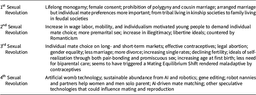
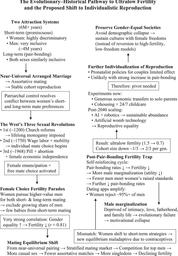
Source : https://www.cambridge.org[...]0B666344157278B72CFC5D223
Quelques extraits :
Not only do women now have free mate choice, but their professional empowerment has reduced men’s utility to them, meaning that women have less need for the material resources men bring to a relationship. Consequently, women exclude more men from their pool of potential partners
Female freedoms have brought tremendous benefits to societies and to both sexes in many respects, but experts have often been reluctant to emphasize their relationship to ultralow fertility. Some fear an anti-feminist backlash
Using the Gender Inequality Index from the Human Development Report (UNDP, 2025) and national fertility rates from World Population Prospects (United Nations, 2024), we found a very strong correlation between gender equality and low fertility (r ≈ 0.81, N = 172).
If we are unlikely to sufficiently increase pair-bonding rates, policymakers should consider other means for helping women have the number of children that they themselves say they want.
Such financial transfers, however, would further reduce men’s utility to women, and thus the mate value of some groups of men, likely exacerbating male marginalization. Still, the existential stakes of the fertility crisis could justify such drastic measures.
6 million years ago, our great ape ancestors probably lived in large multimale, multifemale groups who mated promiscuously (no pair-bonds, multiple sexual partners). In such mating regimes, females channel reproductive opportunities mostly to the highest-ranking males
When monogamy is the norm, the sexes practice assortative mating, meaning that individuals pair up with someone of similar long-term mate value. Such matching, of men and women with equivalent mate values, is the backbone of stable, long-term pair-bonds
If young women were free to have sex with the men to whom they felt most attracted—those who fulfilled both short- and long-term preferences—they would run a greater risk of abandonment by seductive men who were willing to copulate but not to pair-bond with them. Similarly, a community could impose severe sanctions to constrain the high-value men whose promiscuous inclinations could cause social conflict and mating disputes. It is common to emphasize that past mating regimes oppressed women, but in our evolutionary-historical past, neither sex had the privilege of free mate choice.
Les conséquences de la 2ème révolution sexuelle du XVIIIème siècle
Contrecoup conservateur au XIXème siècle (la technologie n'était pas encore là pour permettre aux femmes de faire n'importe quoi)
Qui aurait pu prévoir ?
Merci Cohn-Bendit
Qui aurait pu prévoir²
 Ahi
Sur Tinder
Ahi
Sur Tinder
 Pump & dump
Qui aurait put prévoir ^3
80/20, littéralement
Une conséquence et non une cause
On a cassé la machine
L'inévitable intervention par la socialisation d'État pour palier aux conséquences de l'individualisme libéral et ce jusque dans la reproduction. Fascinant.
Le prolétariat sexuel risque de vouloir reprendre le contrôle des moyens de reproductions
 Synthèse :
A strong increase in premarital sex resulted in more of them being left to care for offspring on their own. Illegitimacy doubled in England, while quadrupling in France and Germany. In Paris, the number of abandoned babies tripled. In Stockholm, half of childbirths were by unwed mothers (Borgström, Reference Borgström and Lauritzen1994; Coontz, Reference Coontz2005; Seccombe, Reference Seccombe1992). These pregnancies often resulted from higher-status men seducing lower-class women with promises of marriage, but leaving them when they became pregnant
New culture, most prominently exemplified by Romanticism, sought to reattach copulation to pair-bonding (Larsen, Reference Larsen2025a). After 1850, illegitimacy rates declined across the West (Shorter, Reference Shorter1975). The costs of individualized mate choice were simply too large in impoverished environments where women lacked gender equality and reliable contraceptives.
Many women experienced that getting attractive men to bed was easy, but having the same men commit to a relationship far harder
In the 1950s, before the Third Sexual Revolution, marriage had been near-universal across the West. People married early, often reproduced quickly thereafter, and divorce was rare. From the 1970s on, Western people married later, divorce rates skyrocketed, pre-marriage sex became the norm, and the sex division of labor was greatly reduced
While it might be uncomfortable, it is crucial to acknowledge that female emancipation required a return to the marginalization of the least sought-after men. Male marginalization, here, denotes the exclusion of men from pair-bonding and reproduction.
How this aspect of male long-term utility has changed after the Third Sexual Revolution, we argue, explains much of why women to an increasing extent exclude the least sought-after men: they have no crucial resources to offer.
For instance, Harper et al. (Reference Harper, Dittus, Leichliter and Aral2017) found that from 2002 to 2011–13, the top 5% of American men increased their number of sex partners by 32%, while a similar reduction in sex partners occurred across men in the lower percentiles.
While the pill empowered women to pursue the most attractive men with less risk of pregnancy, apps like Tinder give them easy, practically unlimited access to the most compelling men. Women have increasingly used this advantage to further restrict their dating pool. In 2014, female Tinder users were about three times as discriminatory as the male ones, while today they reject 10 times as many profiles (Bilton, Reference Bilton2014; Gerrard, Reference Gerrard2021). According to Gerrard (Reference Gerrard2021), the average woman first swipes away around 95% of men. In the chatting phase, 98% of the remainder is filtered out before the woman commits to a date
the top 1% of men receive 16% of women’s likes, the top 15% receive 50%, while the bottom 50% are left with 4% of women’s likes
Strong female intrasexual competition over the most sought-after men causes the dating process to unfold more according to male preferences (Goetz et al., Reference Goetz, Weisfeld, Zilioli, Welling and Shackelford2019b; Larsen, Reference Larsen and Shackelford2023)—which can motivate women to offer sex earlier than what they themselves would prefer.
For many women, the consequence of increasing female choosiness and competition is having to spend their most fertile years languishing in unfulfilling “situationships” that rarely transform into pair-bonds
their channeling of women primarily to the most attractive men contributes to how many men become incels (involuntary celibate), while many women become insings (involuntary single)
Men’s ratings spread across a bell curve, meaning that a few women were judged to be very attractive or un-attractive, while the majority were in the middle. By contrast, women concluded that over 80% of men had below-average attractiveness
Apps reflect and accentuate the modern world’s mating challenges, but the main underlying driver of increased singledom, we argue, is how some groups of men have lost so much utility to women that fewer fulfill women’s requirements for a long-term partner
Our genes, however, are unaware that we have invented reliable birth control. When women serially date and have sex with the highest-value men (Larsen & Kennair, Reference Larsen and Kennair2025), gene replication is rarely the outcome. With the invention of the pill, we may have checkmated our genes but potentially also our future survival.
The attentive reader might object that such a development implies a socialization of reproduction, as the costs of offspring to a greater extent would be carried by society. That is correct; we propose an increasing socialization of the costs of reproduction but an individualization of the choice of having children.
Given the increasingly dire situation for certain groups of men, communities should not underestimate the potential for resentment and misogyny arising from mating exclusion; a marginalized male underclass could become a destabilizing societal force
Source :
il y a 4 jours


Pourquoi personne ne up, c'est hyper intéredsant comme topax

Messages générés automatiquement. Merci de signaler les messages hors-la-loi via mp. Ils sont supprimés dans les 24h.
il y a 2 jours


Ce papier est hallucinant d'honnêteté. Il confirme TOUTES les théories des incels. Par contre la réponse apportée est hilarante. Il propose pour résoudre la question de la chute de la natalité de faire des hommes des sous-citoyens, de quasi-esclaves dont l'Etat extrairait les ressources pour les redistribuer aux femmes qui feraient des bébés toutes seules. Comment faire passer la pilule ? En ouvrant la GPA aux hommes. Plutôt ça que de revenir sur la libération sexuelle et l'égalité de sexes.
Quelques extraits :
Celui-ci est hilarant superposé à la solution proposée par les chercheurs mdr:
Egalité = pas de bébés
Vous allez payer les beta orbiters, que vous le voulez ou non :
Retour 6 millions d'années en arrière grâce au féminisme mdr :
Monogamie = les 8 avec les 8, les 4 avec les 4
Civilisation = restriction des stratégies de reproduction des femmes et des hommes
Les 4 révolutions sexuelles
Source : https://www.cambridge.org[...]0B666344157278B72CFC5D223
Quelques extraits :
Not only do women now have free mate choice, but their professional empowerment has reduced men’s utility to them, meaning that women have less need for the material resources men bring to a relationship. Consequently, women exclude more men from their pool of potential partners
Female freedoms have brought tremendous benefits to societies and to both sexes in many respects, but experts have often been reluctant to emphasize their relationship to ultralow fertility. Some fear an anti-feminist backlash
Using the Gender Inequality Index from the Human Development Report (UNDP, 2025) and national fertility rates from World Population Prospects (United Nations, 2024), we found a very strong correlation between gender equality and low fertility (r ≈ 0.81, N = 172).
If we are unlikely to sufficiently increase pair-bonding rates, policymakers should consider other means for helping women have the number of children that they themselves say they want.
Such financial transfers, however, would further reduce men’s utility to women, and thus the mate value of some groups of men, likely exacerbating male marginalization. Still, the existential stakes of the fertility crisis could justify such drastic measures.
6 million years ago, our great ape ancestors probably lived in large multimale, multifemale groups who mated promiscuously (no pair-bonds, multiple sexual partners). In such mating regimes, females channel reproductive opportunities mostly to the highest-ranking males
When monogamy is the norm, the sexes practice assortative mating, meaning that individuals pair up with someone of similar long-term mate value. Such matching, of men and women with equivalent mate values, is the backbone of stable, long-term pair-bonds
If young women were free to have sex with the men to whom they felt most attracted—those who fulfilled both short- and long-term preferences—they would run a greater risk of abandonment by seductive men who were willing to copulate but not to pair-bond with them. Similarly, a community could impose severe sanctions to constrain the high-value men whose promiscuous inclinations could cause social conflict and mating disputes. It is common to emphasize that past mating regimes oppressed women, but in our evolutionary-historical past, neither sex had the privilege of free mate choice.
Les conséquences de la 2ème révolution sexuelle du XVIIIème siècle
Contrecoup conservateur au XIXème siècle (la technologie n'était pas encore là pour permettre aux femmes de faire n'importe quoi)
Qui aurait pu prévoir ?
Merci Cohn-Bendit
Qui aurait pu prévoir²
Ahi
Sur Tinder
Pump & dump
Qui aurait put prévoir ^3
80/20, littéralement
Une conséquence et non une cause
On a cassé la machine
L'inévitable intervention par la socialisation d'État pour palier aux conséquences de l'individualisme libéral et ce jusque dans la reproduction. Fascinant.
Le prolétariat sexuel risque de vouloir reprendre le contrôle des moyens de reproductions
Synthèse :
A strong increase in premarital sex resulted in more of them being left to care for offspring on their own. Illegitimacy doubled in England, while quadrupling in France and Germany. In Paris, the number of abandoned babies tripled. In Stockholm, half of childbirths were by unwed mothers (Borgström, Reference Borgström and Lauritzen1994; Coontz, Reference Coontz2005; Seccombe, Reference Seccombe1992). These pregnancies often resulted from higher-status men seducing lower-class women with promises of marriage, but leaving them when they became pregnant
New culture, most prominently exemplified by Romanticism, sought to reattach copulation to pair-bonding (Larsen, Reference Larsen2025a). After 1850, illegitimacy rates declined across the West (Shorter, Reference Shorter1975). The costs of individualized mate choice were simply too large in impoverished environments where women lacked gender equality and reliable contraceptives.
Many women experienced that getting attractive men to bed was easy, but having the same men commit to a relationship far harder
In the 1950s, before the Third Sexual Revolution, marriage had been near-universal across the West. People married early, often reproduced quickly thereafter, and divorce was rare. From the 1970s on, Western people married later, divorce rates skyrocketed, pre-marriage sex became the norm, and the sex division of labor was greatly reduced
While it might be uncomfortable, it is crucial to acknowledge that female emancipation required a return to the marginalization of the least sought-after men. Male marginalization, here, denotes the exclusion of men from pair-bonding and reproduction.
How this aspect of male long-term utility has changed after the Third Sexual Revolution, we argue, explains much of why women to an increasing extent exclude the least sought-after men: they have no crucial resources to offer.
For instance, Harper et al. (Reference Harper, Dittus, Leichliter and Aral2017) found that from 2002 to 2011–13, the top 5% of American men increased their number of sex partners by 32%, while a similar reduction in sex partners occurred across men in the lower percentiles.
While the pill empowered women to pursue the most attractive men with less risk of pregnancy, apps like Tinder give them easy, practically unlimited access to the most compelling men. Women have increasingly used this advantage to further restrict their dating pool. In 2014, female Tinder users were about three times as discriminatory as the male ones, while today they reject 10 times as many profiles (Bilton, Reference Bilton2014; Gerrard, Reference Gerrard2021). According to Gerrard (Reference Gerrard2021), the average woman first swipes away around 95% of men. In the chatting phase, 98% of the remainder is filtered out before the woman commits to a date
the top 1% of men receive 16% of women’s likes, the top 15% receive 50%, while the bottom 50% are left with 4% of women’s likes
Strong female intrasexual competition over the most sought-after men causes the dating process to unfold more according to male preferences (Goetz et al., Reference Goetz, Weisfeld, Zilioli, Welling and Shackelford2019b; Larsen, Reference Larsen and Shackelford2023)—which can motivate women to offer sex earlier than what they themselves would prefer.
For many women, the consequence of increasing female choosiness and competition is having to spend their most fertile years languishing in unfulfilling “situationships” that rarely transform into pair-bonds
their channeling of women primarily to the most attractive men contributes to how many men become incels (involuntary celibate), while many women become insings (involuntary single)
Men’s ratings spread across a bell curve, meaning that a few women were judged to be very attractive or un-attractive, while the majority were in the middle. By contrast, women concluded that over 80% of men had below-average attractiveness
Apps reflect and accentuate the modern world’s mating challenges, but the main underlying driver of increased singledom, we argue, is how some groups of men have lost so much utility to women that fewer fulfill women’s requirements for a long-term partner
Our genes, however, are unaware that we have invented reliable birth control. When women serially date and have sex with the highest-value men (Larsen & Kennair, Reference Larsen and Kennair2025), gene replication is rarely the outcome. With the invention of the pill, we may have checkmated our genes but potentially also our future survival.
The attentive reader might object that such a development implies a socialization of reproduction, as the costs of offspring to a greater extent would be carried by society. That is correct; we propose an increasing socialization of the costs of reproduction but an individualization of the choice of having children.
Given the increasingly dire situation for certain groups of men, communities should not underestimate the potential for resentment and misogyny arising from mating exclusion; a marginalized male underclass could become a destabilizing societal force
Source :
Entre transhumanisme et retour à l'anthropologie des hommes des cavernes

Subventionner les mères célibataires ca se fait déjà dans de nombreux pays, l'accès à la GPA/PMA solo aussi et ca augmente pas la natalité
Faut les laisser se tortiller à essayer de comprendre la civilisation, ils ne résoudront de toute façon jamais se problème et arriveront à la conclusion déjà à moitié évoqué dans l'article que l'Etat doit employer des femmes ou dev des utérus artificielles puis éduquer les enfants lui même

Dans tous les cas ils ne se reproduisent pas et à la fin il restera que les familles
Subventionner les mères célibataires ca se fait déjà dans de nombreux pays, l'accès à la GPA/PMA solo aussi et ca augmente pas la natalité
Faut les laisser se tortiller à essayer de comprendre la civilisation, ils ne résoudront de toute façon jamais se problème et arriveront à la conclusion déjà à moitié évoqué dans l'article que l'Etat doit employer des femmes ou dev des utérus artificielles puis éduquer les enfants lui même
Dans tous les cas ils ne se reproduisent pas et à la fin il restera que les familles
il y a 2 jours


Pourquoi personne ne up, c'est hyper intéredsant comme topax
Je parle pas anglais

Partie du fdce.Pour le retou de l'errance chevaleresque https://onche.org/topic/5[...]u-chevalier-errant#messag
il y a 2 jours
Je parle pas anglais
Les navigateurs ont une fonction de traduction automatique en 2k26

il y a 2 jours
En ligne
139
Sur ce sujet0